How a Flooring Project Runs in a Building You Can't Shut Down

Most flooring projects happen in buildings that keep going. Patients still need care. Students still have class. Staff still show up at eight. The building doesn't pause because there's a flooring crew on the third floor, and nobody expects it to.
What they do expect is that the contractor figured that out before they showed up.
Working in occupied buildings is a different discipline than working in a building under construction. The tools are the same. The product is the same. Everything around the work, the planning, the sequencing, the communication, has to account for the fact that real people are using the space while the work is happening.
Here's what that actually looks like in practice.
Phasing is the whole game
In an occupied building, you rarely do the whole floor at once. You work in sections. One wing while the other stays open. One floor while the building operates normally around it. Common areas overnight or on weekends when traffic drops.
Good phasing starts with understanding how the building actually functions, not just how it looks on a drawing. Where do people move between areas? Which corridors can't close, even temporarily? Where are the noise-sensitive spaces? What are the hours when disruption is most tolerable?
That conversation needs to happen with the facility manager before the schedule gets built, not after the crew is already on site asking which way to go. A phasing plan built around how the building operates is completely different from one built around what's most convenient for the flooring contractor.

Adhesive odours are a real issue and they're manageable
This is the one facility managers ask about most, and for good reason. Some flooring adhesives off-gas during and after application. In a hospital, a school, or an office building with people in it, that's not a minor inconvenience. It's a health and operations concern.
The answer isn't to pretend the odour doesn't exist. It's to plan around it. Low-VOC adhesive systems are available for most commercial applications and should be the default in occupied settings. Work sequencing can be structured so adhesive application happens when ventilation is highest and occupancy is lowest. In sensitive environments like healthcare, this often means overnight or weekend shifts for the adhesive-heavy portions of the work.
If a contractor tells you odour won't be an issue without asking anything about your building, ventilation system, or occupancy schedule, that's worth probing. It's manageable. It requires a plan.
Noise and dust don't have to be a crisis
Floor preparation work is loud. Grinding, shot blasting, and demo generate noise and dust that can travel well beyond the immediate work area. In a functioning building, that matters.
Dust containment barriers, HEPA vacuums running during grinding, and scheduling noisy work during low-occupancy windows are all standard practice on occupied projects. They add coordination time. They're not optional.
The facility managers who have the smoothest flooring projects are the ones who asked about noise and dust management upfront and got specific answers, not general reassurances. "We'll keep it clean" is not a dust management plan. A list of containment measures and a schedule that keeps the noisiest work away from occupied hours is.

Communication is what keeps the building running normally
Even the best-planned occupied building project will have moments where something needs to change. A section runs longer than expected. A product delivery is delayed. A corridor needs to stay closed an extra day.
How that gets communicated makes all the difference. Facility managers need enough notice to reroute staff, adjust signage, communicate with tenants, and manage the building's daily operations around the change. Finding out at seven in the morning that a corridor is closed is a different experience than finding out the afternoon before.
The expectation should be set at the start: how will changes get communicated, to whom, and with how much notice. A flooring contractor who's done occupied building work before has a process for this. One who hasn't tends to communicate reactively, when the situation is already in motion.
Access logistics matter more than people expect
Getting material into an occupied building isn't as simple as pulling up to the loading dock. Elevator reservations, security clearances, restricted access hours, parking limitations for delivery vehicles. Every building is different, and the facility manager knows the rules better than anyone.
The pre-mobilization conversation should cover all of it. Which entrance, which elevator, what hours, who to call when there's a question on site. A crew that shows up without that information figured out in advance creates friction from the first day.
It's a small thing that signals a lot. Contractors who ask those questions before they arrive are the ones who've thought through what it actually means to work in someone else's building while it's in use.
What a well-run occupied building project actually feels like
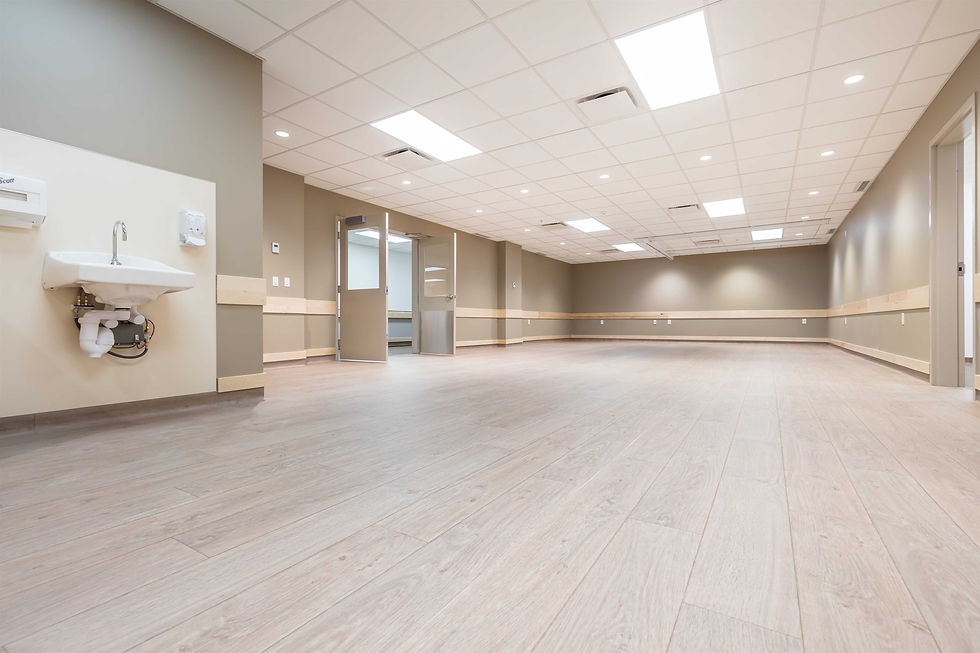
When it goes right, a flooring project in an occupied building is almost invisible to the people using it. They see progress. They don't experience chaos. Corridors reopen when they're supposed to. Nobody gets a surprise about a closed stairwell at eight in the morning. The smell on floor three doesn't trigger a facilities complaint.
That outcome isn't accidental. It's the result of planning that started before the crew mobilized, communication that stayed consistent through the project, and a contractor who understood that the building's operations weren't an obstacle to work around. They were the context the whole project had to fit inside.
Universal Flooring Systems has worked in hospitals, long-term care facilities, schools, and occupied office buildings across Southern Alberta and Interior BC. If you're planning a flooring project in a functioning building and want to talk through what the process looks like, reach out.